
Le Guin Daodejing: Chapter 1
Gratitude Series

[Author’s Note: Working with a “new” article type, a compilation from Medium. I have a Gratitude Series on Medium based on the interpretation of the Daodejing by Ursula Le Guin. Each week features a short article based on one verse of a single chapter. I am starting with Chapter 1, Verse 1, and will continue until the final verse of Chapter 81. I thought to share each Chapter as a compilation on Medium as each chapter is completed. So what you are reading here is four articles welded together. First I share Ms. Le Guin’s chapter in entirety, followed by the Medium publication date. I will continue to experiment with this format to see what works best. Your support and any feedback is welcome.]
Chapter 1: TAOING
(1) The way you can go isn’t the real way. The name you can say isn’t the real name.
(2) Heaven and earth begin in the unnamed: name’s the mother of the ten thousand things.
(3) So the unwanting soul sees what’s hidden, and the ever-wanting soul sees only what it wants.
(4) Two things, one origin, but different in name, whose identity is a mystery. Mystery of all mysteries! The door to the hidden.
(Published on Medium January 1, 2026.)
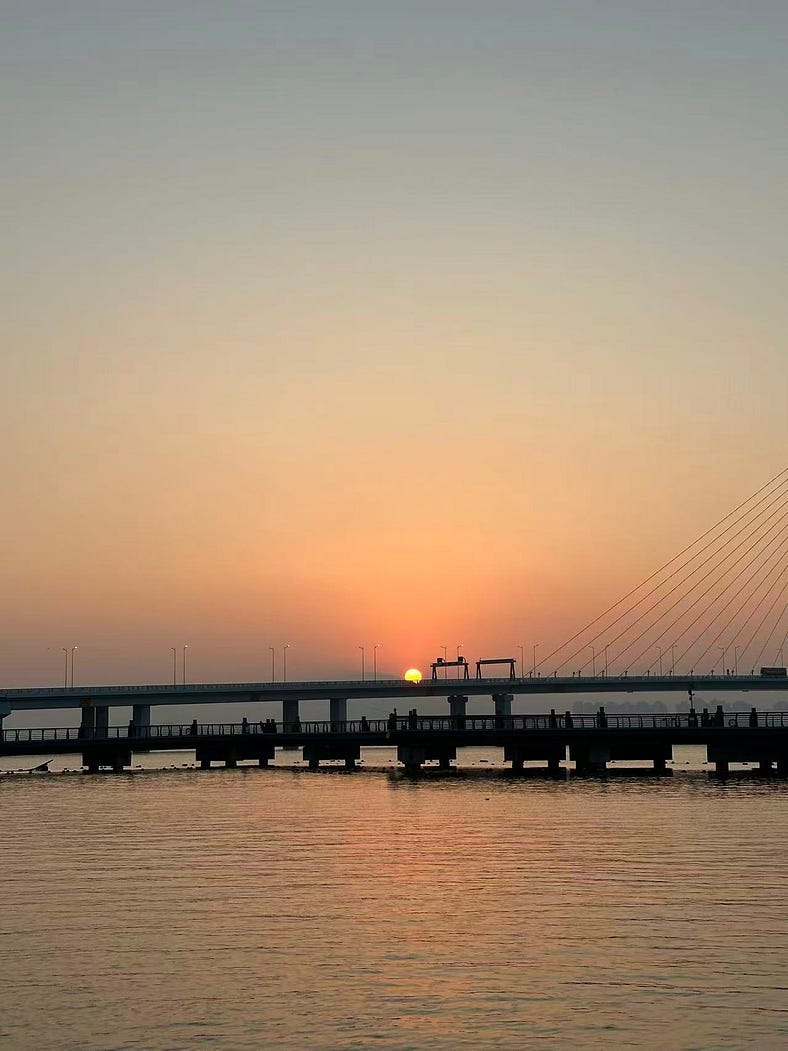
Here we are. Any first is special. A new project, a new expression of meaning. Yet this step is only the next in our random walk of discovery. A walk that has set me on a path that has taken me through a corporate career, finding my home and family in China, to the Daodejing and meditation, to a writing hobby that has become a passion of sorts, and so onward.
If you are new to my version of a gratitude journal, I provide an introduction to the book we are using here. There are a multitude of interpretations of Laozi’s Daodejing. Ms. Le Guin’s version leans into the poetry, highlighting the depth of the ideas contained within. So much so that I will base each entry on a single passage within a chapter (in bold).
This writing is ideally completed in one sitting, an extended moment. I may share where I am, recent events or plans, or so on in future instalments. Let’s see how this goes. I appreciate your feedback.
TAOING
The way you can go isn’t the real way. The name you can say isn’t the real name.
Heaven and earth begin in the unnamed: name’s the mother of the ten thousand things.
So the unwanting soul sees what’s hidden, and the ever-wanting soul sees only what it wants.
Two things, one origin, but different in name, whose identity is a mystery. Mystery of all mysteries! The door to the hidden.
“TAOING” has cleverness, don’t you think? A verb imparts action and motion to a thing we do. We practice the Tao (or Dao), we live, work, and play within it. There are no wrong ways, only ways more or less right for us. There is no way to say why or explain what we do, but we all understand intuitively that trying to communicate with each other enriches and brings pleasure to our collective existence.
Can there be a real way? I think even more than the concept of right or wrong, there is no right or correct path of getting from here to wherever there is.
I’m grateful for the random walk of life.
It is wonderful that we don’t know what will happen next. Practicing an open mind to change and the unexpected prepares us for all sorts of surprises and protects us from the paralyzing fear of the unknown. Fear makes us rigid, a false kind of brittle strength that betrays us at the moment of need. I wish you the strength today to accept your fears and take the steps past them.
(Published on Medium January 22, 2026.)
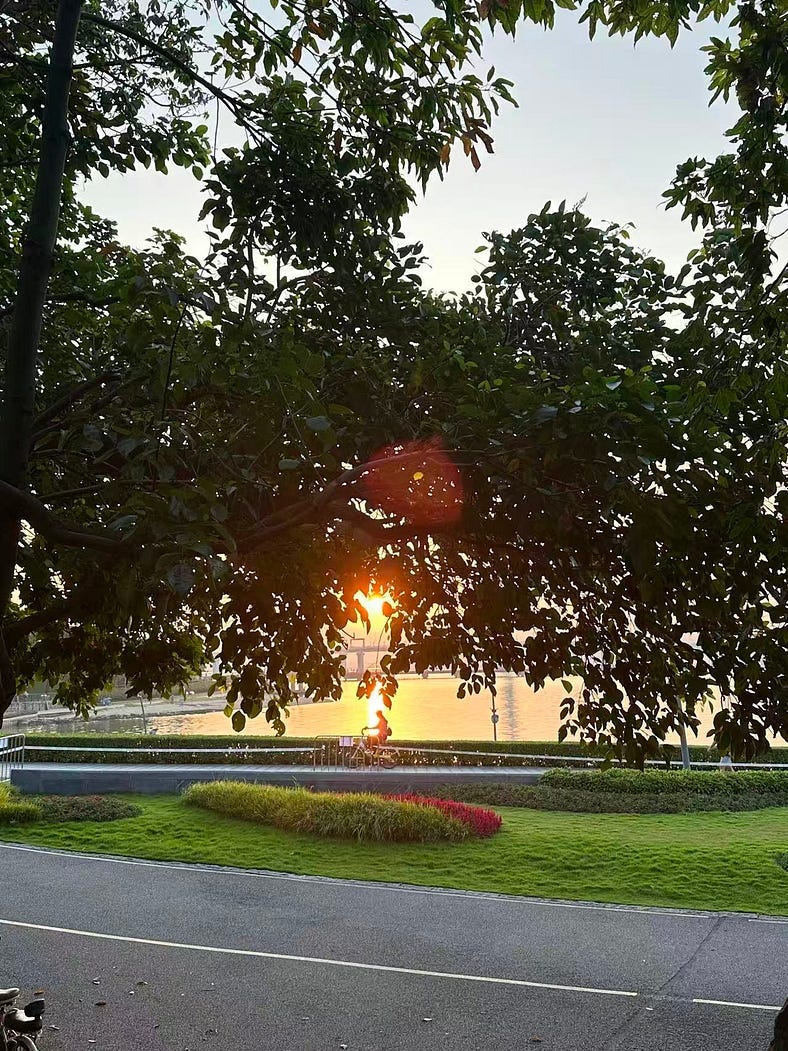
I’ve always been more of a morning person than a night owl. As the years pile up, my internal clock drifts ever earlier and I appreciate sleep more. But for some years now, particularly since the pandemic, I wake before sunrise, which grants some advantages. Being there for sunrises, for one. Walks to the park in the moments before dawn are some of the most reliably peaceful.
The moments when the mind is most quiet, but never still. Thinking, always thinking, not about the minutiae of the coming day, but the motivations that give moment to the minutiae.
TAOING
The way you can go isn’t the real way. The name you can say isn’t the real name.
Heaven and earth begin in the unnamed: name’s the mother of the ten thousand things.
So the unwanting soul sees what’s hidden, and the ever-wanting soul sees only what it wants.
Two things, one origin, but different in name, whose identity is a mystery. Mystery of all mysteries! The door to the hidden.
I find it comforting that everything heaven and earth exists under the same framework, the same rules. There is a fairness and belonging in that. It would be so simple to view much of existence as unfair. We get thrown into life without a say in the circumstances, resources, or conditions of the world. But the Dao, or Nature, doesn’t work on principles of fair and unfair, only the probabilities of what could happen. All the randomness manages to even out in such a way that almost anything becomes possible. We can make a better world, because that is possible. We can leave it to others, depend on others, collaborate or go it alone in our own way, all because the chance is there.
I’m grateful to take what chance has afforded me and see what can be done with it.
No thumb on the scale, no judgment. I accept the chance to try, and accept the outcome. That is all any of us can do. Though we have tried every trick, to pass blame, to raise ourselves above others, none of that has ever really worked. In a way, we are free. Being one of ten thousand (million-billion) things, we can afford to laugh.
Thank you for being here today.
(Published on Medium January 29, 2026.)
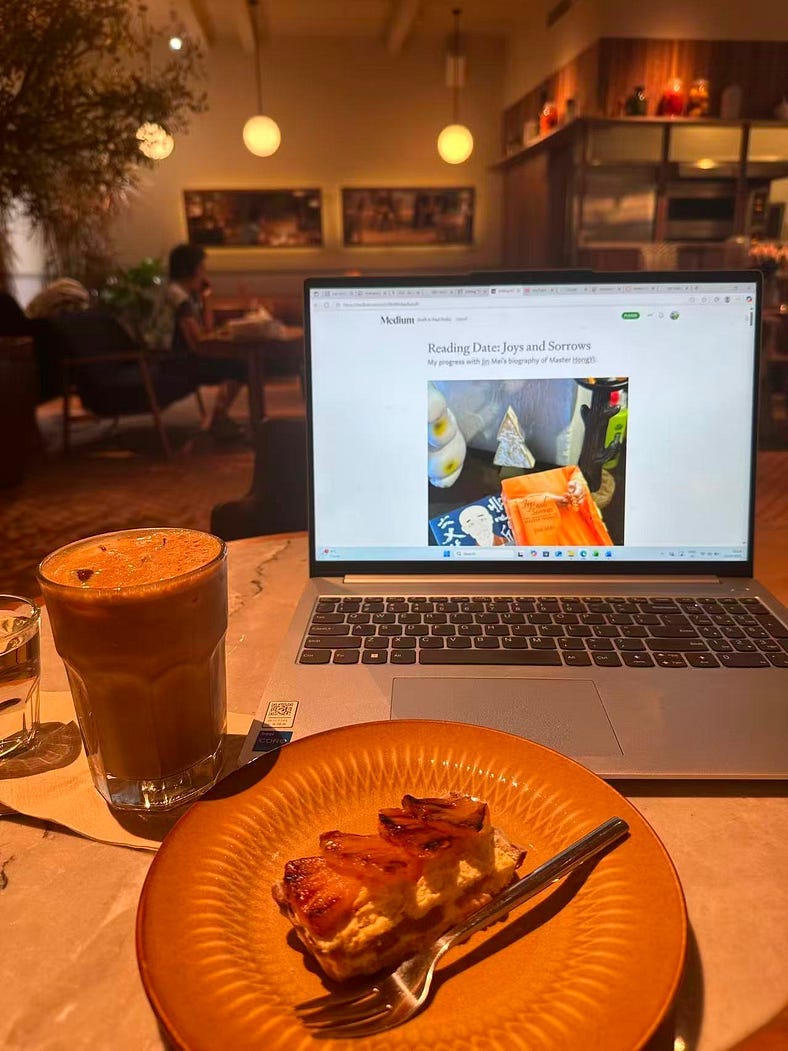
Today feels new in more ways than one. The first cool days of Fall are reaching Shenzhen. I find it hard to think the year is coming to a close while the weather seems to be stuck on Summer. Today I’m feeling quite back to normal after spending all of last week fighting a nasty flu. Losing a week of training was a bummer but the decision was out of my hands. I tried on Monday and discovered I couldn’t do even half of what was expected. Makes one stop and consider the illusions of control that we rely on every day. We can only loosely predict what tomorrow may hold, prepare as best we can, but accepting and adjusting accordingly is the best skill to practice.
TAOING
The way you can go isn’t the real way. The name you can say isn’t the real name.
Heaven and earth begin in the unnamed: name’s the mother of the ten thousand things.
So the unwanting soul sees what’s hidden, and the ever-wanting soul sees only what it wants.
Two things, one origin, but different in name, whose identity is a mystery. Mystery of all mysteries! The door to the hidden.
The “unwanting soul” is the perfectly accepting attitude, isn’t it? It is a state I’m far from but would welcome finding myself in. Like a journey along a multi-dimensional spectrum, I hopefully drift closer to this intention. I know living with the ever-wanting soul, because I was one, and knowing this gives me the sense of direction.
It’s not the trying that trips us up, but the judgment we expect to foist on ourselves after the outcome is clear. The unwanting soul finds a way to live in a space where we accept giving the best we can, and realizing that every outcome is just an outcome.
I’m grateful that I know what greed and selfishness feels like.
Gentle reminders are good for the mind, I think. After experiencing a week where I had to adjust plans and expectations, I’m appreciating the opportunity to keep trying. Let’s see what surprises existence has for us. I wish you a great week. Be kind to yourself.
(Published on Medium February 5, 2026.)
I spent a lot of time as a young person, a teenager, wondering “why”. Why am I here? Is there a purpose that unites us all, that we share, a purpose to work towards together?
“Why?”, and “Am I missing something?”
When we are young we have a lot time for this sort of thinking. In college, I had time to attend a meeting of The Young Republicans on campus and listen to Rush Limbaugh on the radio. Didn’t feel right, but took some decade or so to articulate what was the matter. Tried linking my identity to a rock musician, a man I still admire to this day and understand better. But again, no. A few years later in China, I went to Lhasa, Tibet to see the Potala Palace. I really went there to that centre of spirituality to find the answer to what I was missing. For me, it wasn’t.
TAOING
The way you can go isn’t the real way. The name you can say isn’t the real name.
Heaven and earth begin in the unnamed: name’s the mother of the ten thousand things.
So the unwanting soul sees what’s hidden, and the ever-wanting soul sees only what it wants.
Two things, one origin, but different in name, whose identity is a mystery. Mystery of all mysteries! The door to the hidden.
Now that I’m a Dad, I worry that my boys don’t have as much time as I remember having for such quests, which I think vital for getting to who we are and what we decide to stand for. There is so much to learn, so many skills to acquire. Feels like the threshold of success is higher, and the window narrower. That view of the present is normal, but knowing that doesn’t stop me from feeling for them.
I stopped actively searching for some years. Maybe I got frustrated and gave up a bit, maybe I decided the search could wait while going all in on a subset of life’s experience (I worked too much). This isn’t the Way to do it. Even low energy, running in the background, we need the search to continue or we begin to drift. Finding our way back can be hard.
I’m grateful for the search, not the answer.
Contemplating the mysteries of Nature, The Way, or whatever, is a search that rewards consistency. There is no answer, there are infinite answers, either way, actively collaborating with our fellows is how we keep shining our light on the hidden.
Never stop Taoing.
[Author’s Note: This book can be enjoyed by and benefit everyone. Find it on Amazon here.]
[Author’s Note: Thank you for taking the time to visit. All pictures were taken by the author or family member, unless otherwise noted.]
With all due respect to Ursula Le Guin, interpretations of an ancient text which take liberties with that text only serve to take us further from what possible meanings there might have been in the original, and it becomes something completely different. Layers upon layers of historical and cultural misinterpretations, beginning with the Jesuits, who attemped to Christianize the DDJ preceded LeGuin. As for "dao-ing" , there are some scholarly points of view about translating classical Chinese with verbs, nouns etc. Ames and Hall attempt to 'solve' this issue by using "way-making' : which personally I find clumsy and awkward.
As for her "unwanting soul" and "ever-wanting soul" : again, an unnecessary addition of an english word 'soul' -- which has all kinds of cultural ramifications and meanings -- which is not there in the original. ( I believe this is her version of wuyu 無欲) It is not so simple to find a similar word (and meaning) for "soul" in Chinese: at the very basic, there are considered two souls, the hun and the po -- yang and yin, spiritual and corporeal; and then they get subdivided into three huns and seven pos... etc etc etc.
I realise that Le Guin meant "soul" in the sense that we would colloquially refer to a person, as in "she's an old soul", however in translating or 'interpreting' an ancient religious or spiritual text to use words like soul indicates concepts that are not there in the original and in my opinion only cause to obfuscate rather than enlighten.
Nevertheless, your meditations on how this text has meaning in your life are always relevant to people, Paul. Love the sunrise in Shenzhen picture!!